Same Lunch. Same People. Only Breakfast Changed, and the Lunch Spike Got Smaller.
In this short presentation: the 1982 “second-meal effect,” the “healthy” breakfast that may be tipping the first domino the wrong way, and three simple moves to line the day up in your favor. No keto. No fasting. No carb counting.
The “Healthy” Breakfast That May Be Setting Up Your 2 p.m. Crash, and the 5-Minute Swap Researchers Studied
Cereal, juice and toast can look like the responsible choice. Here’s what published studies suggest it may be doing to the rest of your day, and what to put on the plate instead. No keto. No fasting. No carb counting.
Stop Fighting 21 Meals a Week. Win the First One, and Give the Other 20 a Better Chance.
One breakfast, built a certain way. Two small moves at your biggest meal. Lined up in order, they work like a row of dominoes. No keto. No fasting. No carb counting.
people have started the protocol
Launch price: $37 $19 Save 49%
The launch price and the 3 bonuses end October 31. Then it’s $37.
Tip the first domino your way, starting tomorrow morning
The Anchor Breakfast Protocol: everything from the presentation, done for you. No figuring out, no guessing, just follow the page.
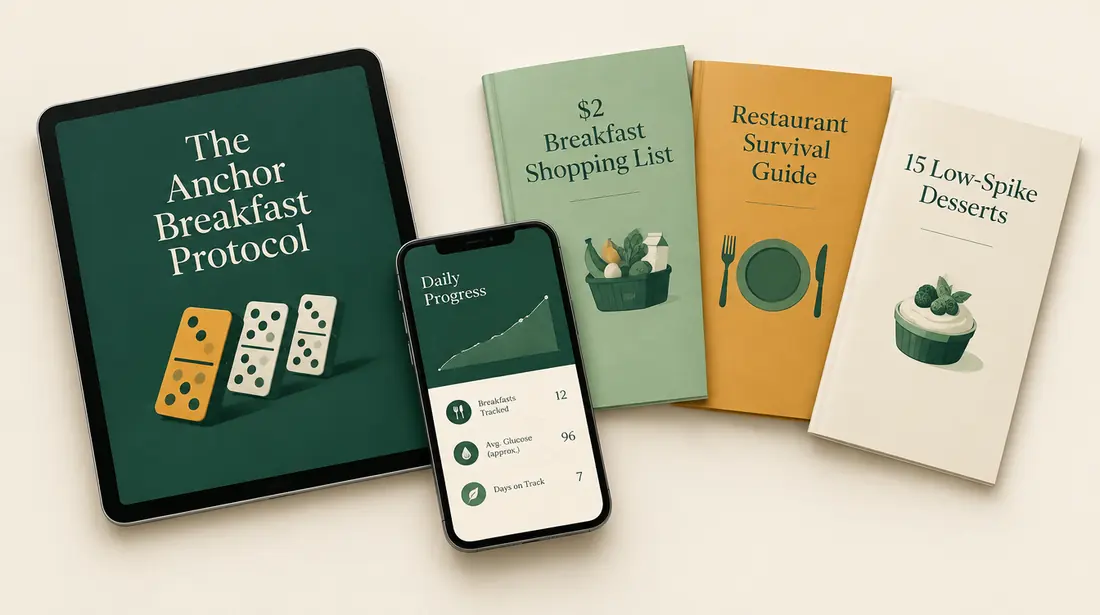
- The Anchor Breakfast Protocol guideThe Glucose Domino Effect in plain English, plus 30 Anchor Breakfasts with photos, shopping lists and nutrition facts~$20
- The 14-Day Kickstart PlanWhat to eat, and in what order, every day for two weeks, with a daily checklist. No guessing~$15
- The Anchor AppRuns in your phone’s browser: log readings and how you feel, see your trend, morning reminder, 10-minute walk timer~$10/mo
- Launch bonuses: free with orders placed before October 31
- Bonus 1: The $2 Breakfast Shopping ListOrganized for big stores like Walmart, Costco, Aldi and Kroger. Walk in with a list, walk out with two weeks of breakfasts~$7
- Bonus 2: Restaurant Survival GuideWhat to order, and in what order, at 30 popular chains, so dinners out don’t knock you off track~$12
- Bonus 3: 15 Low-Spike DessertsReal treats built with protein and fiber, because a plan with no dessert is a plan nobody keeps~$10
Comparable costs are our estimates of typical U.S. prices for similar standalone products (recipe books, meal-plan guides, premium tracking apps, short e-guides). They are not prices we have charged.
For context: a single out-of-pocket visit with a registered dietitian often costs $100 or more. This guide isn’t a replacement for personal care. If your insurance or Medicare covers nutrition counseling, use it.
Yes, send me the protocol for $19people have started the protocol
- Secure checkoutEncrypted, processed by Digistore24
- 90-day guaranteeFull refund, any reason
- Instant accessDigital, nothing ships
We never see your card number: payment is handled by Digistore24, our authorized retailer. Privacy Policy
- Built on published researchEvery study mentioned is cited and linked below.
- Everyday grocery-store foodsEggs, beans, oats, yogurt, chia. Most breakfasts take about 5 minutes.
- 90-day money-back guaranteeRoughly the time between A1c checks.
21 meals a week. 21 tests. And they’re not separate.
You’ve cut sugar. You’ve cut bread. You’ve traded pasta for zucchini noodles you don’t even like. You’ve walked on days you really didn’t feel like walking.
And still, after lunch, it creeps in. The heavy eyelids. The fog. Then the guilt, and the feeling that your own body is working against you.
Here’s what almost nobody tells you: what happens at the first meal shapes what happens at the next. Lose the first test at 7 a.m., and the rest of the day can get harder. So what if you put most of your effort into winning the first one? Look at what that does to the same day:
Two mornings. Same person. A different first domino.
One of these is the breakfast on the side of the cereal box. The other takes about five minutes and costs around two dollars. Watch what each one sets up.
The typical “healthy” breakfast
Bran flakes, skim milk, orange juice, toast with jam. Feels responsible. It’s mostly fast-digesting carbs.
Stomach growling already. A granola bar “to tide you over” starts another rise.
Lunch lands on top of it. Sandwich first, salad maybe.
Heavy eyelids. Foggy head. Counting the minutes until you can lie down, and wondering what you did wrong.
An Anchor Breakfast day
Eggs with black beans and salsa. Protein plus slow fiber. About 5 minutes, about $2.
Built to digest slowly. Protein and fiber tend to keep people fuller, so the mid-morning snack is less likely to call.
Same lunch, smarter order. Vegetables and protein first, bread last.
A 10-minute walk. Around the block, or up and down the hallway.
Illustrative example, not a real person’s data. Individual responses vary widely.
Three small moves, lined up in order
Each of these effects is modest on its own, and most studies behind them were small. The protocol lines them up so each one sets up the next.
The Anchor Breakfast
Protein plus slow, fiber-rich carbs like beans, lentils, steel-cut oats or chia. Built to digest slowly and set up the meals that follow.
Plate Order
Vegetables first, then protein, carbs last, at your biggest meal. Same food, different order. You don’t give anything up.
The 10/10 Finish
A spoonful of vinegar diluted in water about 10 minutes before that meal, and a 10-minute walk after it.
What’s inside
A digital guide you can read on any phone, tablet or computer, plus a simple app that runs in your browser.
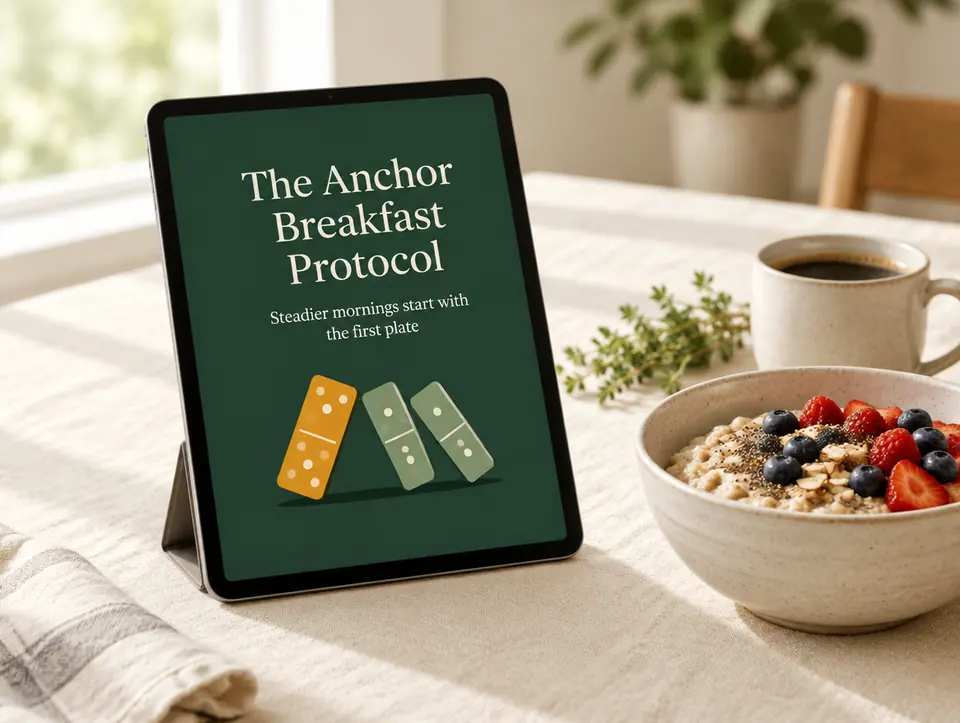
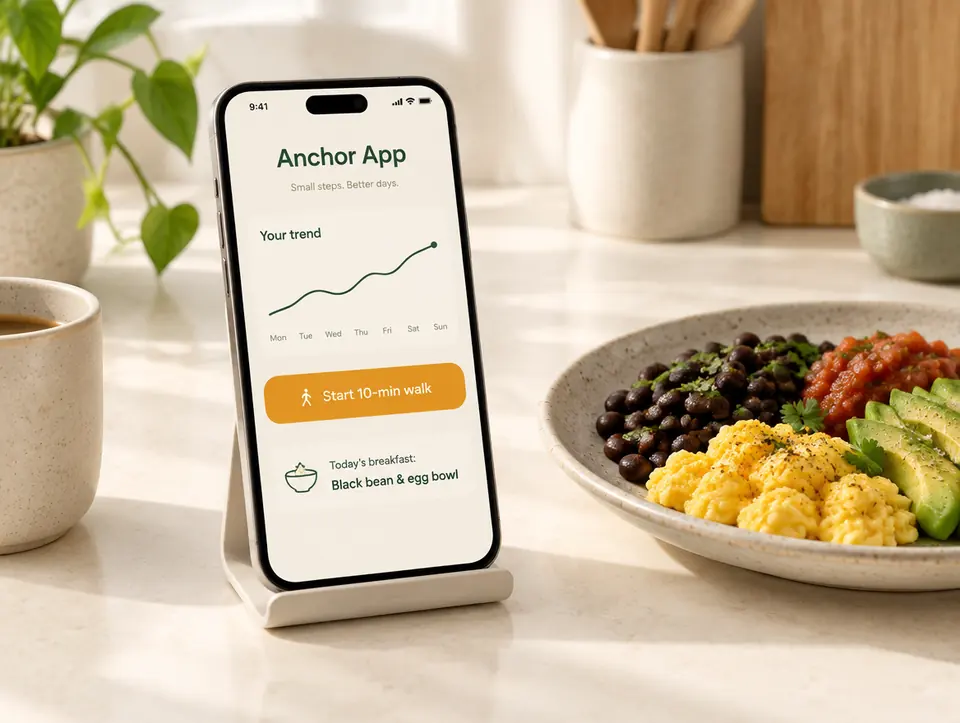
- The Domino Effect, explained in 10 minutesPlain language and simple curve illustrations. No jargon.
- 30 Anchor BreakfastsMexican-style, Mediterranean, diner classics and a sweet oatmeal. Most take about 5 minutes and cost around $2 a serving.
- Plate Order at home and at restaurantsA one-page guide you can keep on the fridge or your phone.
- The 14-day planDay by day, with a checklist. Just follow the page.
Images are product mockups. App screens show sample data for illustration only.
Tomorrow morning could start like this
You open the guide to Day 1. No calorie math, no app store, no special foods. Just a short list.
Five minutes at the stove. Eggs, a scoop of black beans, salsa. You’re eating breakfast that’s built to work with the rest of your day.
Same lunch you’d normally eat. You just start with the salad and chicken, and save the bread for last.
You tap the walk timer and take ten minutes around the block.
You log how the afternoon felt in the app. For once, you’re looking at your own data with curiosity instead of dread.
No one can promise a specific number, and we won’t. Bodies differ. But it costs about five minutes and two dollars a morning to find out how yours responds, and the guarantee gives you 90 days to decide.
Is this a good fit?
It’s made for people who
- Are tired of doing everything “right” while the numbers still won’t cooperate
- Want a simple daily routine built from normal food
- Are done fighting every meal with willpower
- Want to work alongside the plan they have with their doctor
It’s not for people who
- Want a pill, a supplement or a quick fix
- Plan to change their medication without their doctor
- Expect guaranteed numbers. Results vary from person to person
The research, in plain English
What each study actually measured. Small studies, modest effects, honest summaries. Click through and read them yourself.
- Jenkins et al. Am J Clin Nutr, 1982
A lentil breakfast, compared with whole-wheat bread, was followed by a smaller blood sugar rise after the same standard lunch four hours later. Healthy volunteers.
View on PubMed - Nilsson et al. Lund University. Am J Clin Nutr, 2008
Breakfasts with certain fermentable fibers (like boiled barley kernels) were linked to better glucose tolerance at the next meal. Healthy adults.
View on PubMed - Shukla et al. Diabetes Care, 2015
Eating vegetables and protein before carbs: blood sugar about 29% lower at 30 min, 37% lower at 60 min and 17% lower at 2 hours. 11 adults with type 2.
Read the paper - Reynolds et al. Diabetologia, 2016
Advice to walk after meals lowered post-meal blood sugar more than the same amount of walking without specific timing. Adults with type 2.
View the study
The researchers and institutions mentioned are not affiliated with and do not endorse this product.
From people who bought the protocol
Individual experiences; results vary. Not a substitute for medical advice.
Who is behind this

Claire is the presenter and is not a doctor. She has no personal story and reports no personal results. Her job is to walk through published research in plain English and be straight about what it does and doesn’t show.
- Who wrote it. The guide and this page were written by a small independent editorial team at Anchor Breakfast, working from the published studies cited below. We are not doctors, and nothing here is medical advice.
- What it’s based on. Nine peer-reviewed papers, all listed with links in the references. When a study was small or done in healthy volunteers, we say so.
- Who doesn’t endorse it. No university, researcher, store or medical organization endorses this product. We name studies, not endorsements.
- How to reach us. Questions before or after you buy: [email protected]. Orders and refunds are handled by Digistore24, our authorized retailer.
The 90-Day “Next A1c” Guarantee
Your doctor’s A1c test reflects roughly the last three months. So take the full 90 days. Make the breakfasts, try the plate order, take the walks, and see how you feel and what your own numbers do. If you’re not happy for any reason, whether you didn’t notice a difference or just didn’t like the recipes, you get every cent of your purchase price back.
The risk is on us, not you.
- Use it for up to 90 daysEverything stays available while you try it.
- Not happy? Tell usEmail [email protected], or use the refund link in your Digistore24 receipt.
- Get a full refundYour purchase price, processed through Digistore24. No hoops.
Questions people ask
Is this safe with my medication?
It’s everyday food, a little diluted vinegar and a short walk. But if you take insulin or medications that lower blood sugar, eating in a way that steadies glucose, plus walking after meals, can change how much medication you need and in some cases raise the risk of lows. Share this plan with your doctor before you start, keep checking your numbers, and never adjust medication on your own.
I’ve tried everything. Why would this be different?
Most plans ask you to fight all 21 meals a week on willpower. This one puts the effort into the first meal and two small habits at your biggest meal, and lets each one set up the next. You don’t give up your favorite foods; you change the order and the first plate. And with the 90-day guarantee, the only way to lose your money is to decide it’s not for you and not ask for it back.
I don’t have time to cook in the morning.
Most Anchor Breakfasts take about five minutes, and some, like Greek yogurt with chia seeds and berries, need no cooking at all. The 14-day plan tells you exactly what to make, so there’s nothing to figure out at 7 a.m.
I don’t like beans. Will this still work for me?
Beans are one option, not a requirement. The idea is protein plus slow, fiber-rich carbs, and that includes steel-cut oats, chia, barley, Greek yogurt and eggs. The 30 breakfasts cover Mexican-style, Mediterranean, diner classics and sweet options.
Is $19 really one time? Is there a subscription?
One time. No subscription and no trial that turns into a monthly charge. At checkout you may see optional add-ons, which you can skip.
Why is the price going up?Is the launch price still available?
The current price is our launch price. It ends October 31, and after that the price for new buyers is $37. If you buy during the launch, you pay the launch price once and that’s it.The launch period has ended. The price is now $37, one time.
What if it doesn’t work for me?
Then you get your money back. Use the protocol for up to 90 days. If you’re not happy for any reason, email [email protected] or use the refund link in your Digistore24 receipt for a full refund of your purchase price.
Will this cure my diabetes or replace my medication?
No. It’s an educational guide to eating and moving in a way studied for its effect on after-meal blood sugar. It’s meant to work alongside the plan you have with your doctor, never instead of it.
Do I need special foods or a glucose meter?
No special foods. The breakfasts use things like eggs, beans, oats, yogurt and chia from any grocery store. A meter or sensor is optional, and the app lets you log readings if you already check them.
How do I get it? Is my payment secure?
Checkout is handled by Digistore24, our authorized online retailer, so we never see your card number. Right after checkout you’ll get an email with access to the guide (PDF) and a link to the Anchor App at app.anchorbreakfast.online. It’s a digital product. Nothing ships.
Who is Claire?
Claire is the presenter. She isn’t a doctor and doesn’t give medical advice. The content is educational and based on the published studies listed below.
Two ways tomorrow morning can go
Nothing changes
The same cereal or toast. The same 2 p.m. slump. The same knot in your stomach before every reading.
A different first domino
A five-minute breakfast built to work with you. Lunch in a smarter order. A short walk. Your own numbers, watched with curiosity instead of dread.
Same you. Same kitchen. The guide, the 14-Day Kickstart and the app, plus all three launch bonuses, for $19 once instead of $37.
P.S. If you skipped down here, here’s the short version: tomorrow can start with a five-minute breakfast built to set up the rest of your day, instead of the cereal-box breakfast that may be tipping the first domino the wrong way. It’s $19 until October 31, then $37, and the three bonuses go away for new orders at the same moment. And you have 90 days to decide if it’s worth keeping.
P.P.S. If you take medication for blood sugar, share the plan with your doctor before you start and keep checking your numbers. This works alongside your doctor’s plan, never instead of it.
References
- Jenkins DJA, Wolever TMS, Taylor RH, et al. Slow release dietary carbohydrate improves second meal tolerance. Am J Clin Nutr. 1982;35(6):1339–1346. pubmed.ncbi.nlm.nih.gov/6282105
- Jenkins DJA, Wolever TMS, Taylor RH, et al. Glycemic index of foods: a physiological basis for carbohydrate exchange. Am J Clin Nutr. 1981;34(3):362–366. pubmed.ncbi.nlm.nih.gov/6259925
- Nilsson AC, Östman EM, Granfeldt Y, Björck IME. Effect of cereal test breakfasts differing in glycemic index and content of indigestible carbohydrates on daylong glucose tolerance in healthy subjects. Am J Clin Nutr. 2008;87(3):645–654. pubmed.ncbi.nlm.nih.gov/18326603
- Nilsson AC, Östman EM, Holst JJ, Björck IME. Including indigestible carbohydrates in the evening meal of healthy subjects improves glucose tolerance, lowers inflammatory markers, and increases satiety after a subsequent standardized breakfast. J Nutr. 2008;138(4):732–739. doi:10.1093/jn/138.4.732
- Shukla AP, Iliescu RG, Thomas CE, Aronne LJ. Food order has a significant impact on postprandial glucose and insulin levels. Diabetes Care. 2015;38(7):e98–e99. pmc.ncbi.nlm.nih.gov/articles/PMC4876745
- Johnston CS, Kim CM, Buller AJ. Vinegar improves insulin sensitivity to a high-carbohydrate meal in subjects with insulin resistance or type 2 diabetes. Diabetes Care. 2004;27(1):281–282. doi:10.2337/diacare.27.1.281
- Shishehbor F, Mansoori A, Shirani F. Vinegar consumption can attenuate postprandial glucose and insulin responses; a systematic review and meta-analysis of clinical trials. Diabetes Res Clin Pract. 2017;127:1–9. pubmed.ncbi.nlm.nih.gov/28292654
- Reynolds AN, Mann JI, Williams S, Venn BJ. Advice to walk after meals is more effective for lowering postprandial glycaemia in type 2 diabetes mellitus than advice that does not specify timing: a randomised crossover study. Diabetologia. 2016;59(12):2572–2578. doi:10.1007/s00125-016-4085-2
- Buffey AJ, Herring MP, Langley CK, Donnelly AE, Carson BP. The acute effects of interrupting prolonged sitting time in adults with standing and light-intensity walking on biomarkers of cardiometabolic health in adults: a systematic review and meta-analysis. Sports Med. 2022;52(8):1765–1787. pmc.ncbi.nlm.nih.gov/articles/PMC9325803